A New Conversation About Cosmetic Medicine
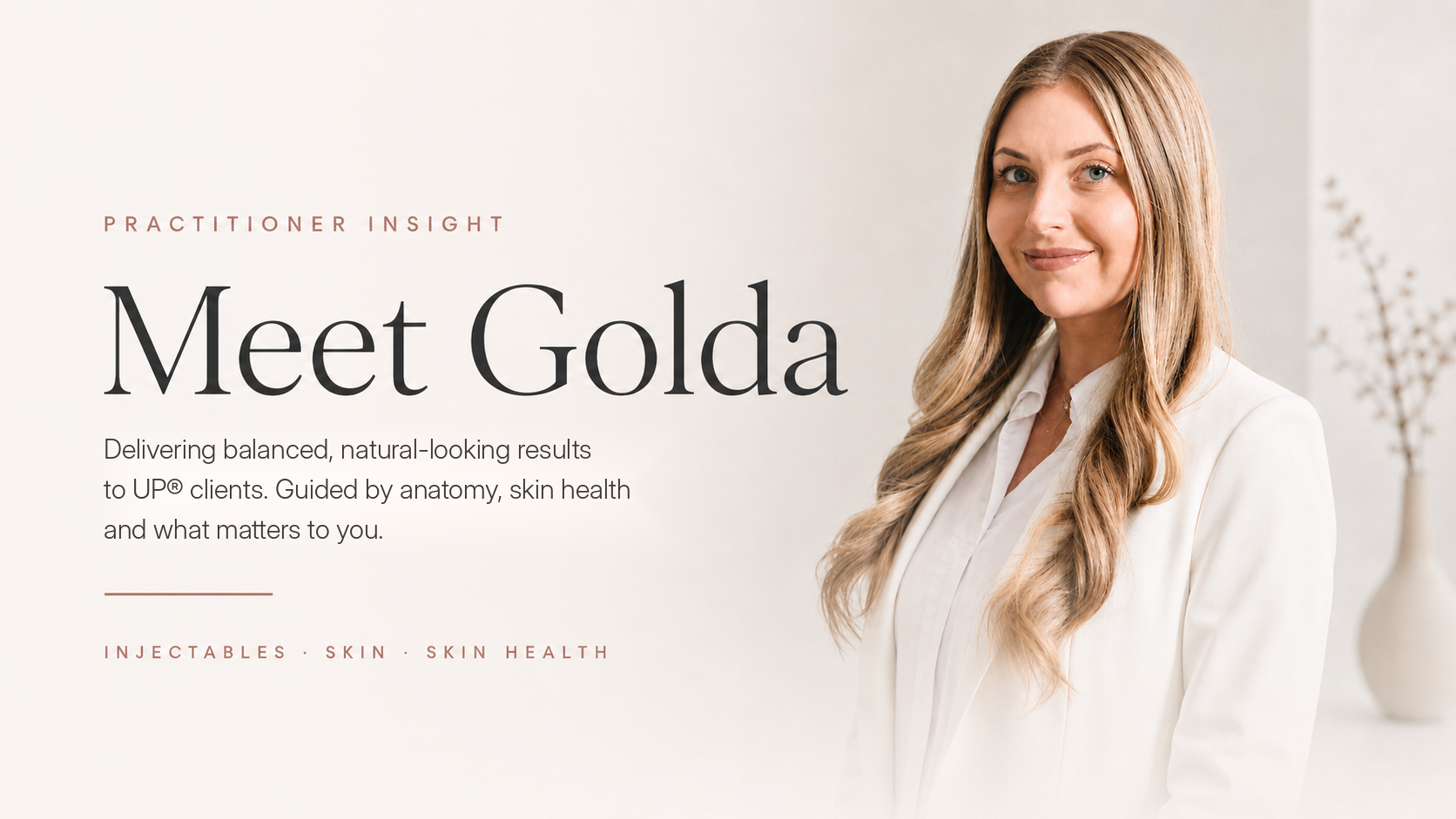
We’re delighted to welcome Golda to UP® Clinical Cosmetics as our Registered Nurse and Cosmetic Injector.
Golda brings experience across nursing, cosmetic medicine, skin health and advanced skin assessment. Having practised for many years in Devonport and later Melbourne, she combines formal qualifications in nursing and cosmetic nursing with a particular interest in facial anatomy, skin health, hormonal change and the wider factors that influence how our skin and appearance change over time.
Her arrival also reflects a broader shift in cosmetic medicine. Increasingly, treatment is becoming less about choosing something from a menu and more about understanding the whole picture — your skin, facial structure, movement, life stage, concerns and goals — then bringing together the options that can help you achieve them.
What excites you most about joining UP®?
What appealed to me was the opportunity to work as part of a broader team rather than treating cosmetic medicine as something that sits in isolation.
UP® already brings together injectables, skin, laser, brows, lashes and SPMU, and I think there is something really exciting about being able to draw on all of that expertise around the same person.
A client might come in thinking about one particular concern, and together we can look at the different ways we could approach it — whether that is one treatment, a sequence of treatments, or two different modalities that work beautifully together.
That collaborative problem-solving is one of the things I am most looking forward to.
How do you think cosmetic medicine is changing?
I think clients are more thoughtful and much better informed than they used to be.
People still come in knowing the treatment they are interested in, but they are also asking more interesting questions: Why has this changed? What is happening to my skin? How can I look fresher without looking different? What could I be doing now to look after things well over time?
I love that, because it makes the consultation much more of a conversation.
We can talk about what someone has noticed, what they already know, what they are curious about and what they would love to achieve — then work through the possibilities together.
When someone says, “My face or skin has changed, but I’m not quite sure what it is,” how do you assess that?
That is actually a very common starting point.
I look at the skin, but also at facial structure, movement, symmetry and how different areas relate to one another. I also want to hear what the person has been noticing themselves — sometimes they know something has changed long before they have the language to describe exactly what it is.
The skin analysis we use at UP® can be really interesting here too. When we go through the images together, we can look more closely at things like pigmentation, redness, texture and skin quality, and start joining the dots between what someone sees in the mirror and what is happening in the skin.
Once you can see the whole picture, there are often several really good ways to approach it. That might involve injectables, skin treatment, laser, or combining different treatments so that each one is doing the job it does best.
How important are hormones and different life stages in that assessment?
Very important.
There are times when people tell me, “My skin just doesn’t feel like my skin anymore,” or “Everything seems to have changed at once.”
That can happen around perimenopause and menopause, but hormonal influences appear at many stages of life. They can affect hydration, elasticity, pigmentation, sensitivity, breakouts, redness and even facial hair.
What I find exciting is that once you understand why those changes are happening, you have so many more useful conversations you can have about what to do next.
It may mean changing the way you look after your skin, introducing a different treatment, combining approaches, or simply updating a plan that worked brilliantly for you five or ten years ago but now needs to evolve with you.
You also have training in dermatoscopy and skin cancer management. How does that influence your approach?
That training has made me incredibly interested in what is happening beneath the surface of the skin.
It teaches you to look closely, to notice patterns and to think about what might be contributing to what you can see — rather than treating every line, patch of pigmentation or change in texture as an isolated feature.
I think that carries beautifully into cosmetic medicine because skin is never just one thing. Hydration, pigment, vascularity, texture, collagen and the way the face moves all interact.
And of course, having that broader skin-health background also means I am comfortable recognising when something deserves closer medical or specialist assessment and helping point someone in the right direction.
A lot of clients say they want to look fresher, more balanced or more like themselves. How do you translate that into a treatment plan?
I actually think those are some of the best things someone can say in a consultation.
“Looking fresher” can mean something completely different from one person to the next.
For one person it may be about skin quality. For someone else it might be softening an area of strong movement, improving pigmentation or redness, subtly changing brow balance, or bringing a little more harmony to the face overall.
And balance does not mean making both sides of the face identical. Every face has character and natural asymmetry.
The fun part is working out what will make the biggest difference while still looking completely like you.
How important is collaboration with the wider UP® team?
It is one of the things I am most excited about.
There are so many situations where combining different perspectives can give us a more complete solution.
Someone may have been concentrating on facials because their skin feels different, for example, and we might start a conversation about whether Profhilo® or a skin booster could complement what they are already doing.
Someone considering SPMU to improve brow symmetry may benefit from looking at brow position and muscle movement as part of the plan, so injectables and SPMU can work in harmony with one another.
Scar treatment is another great example. More complex scars can often be approached from several angles, with nurse-led treatment, microneedling, laser and other skin treatments playing different roles at different stages.
That is what I really like about having different expertise together. We can look at the outcome someone wants and then ask, what combination of our tools is going to get us there most beautifully?
Clients now arrive with an extraordinary amount of information from Google, social media and friends. Is that helpful or frustrating?
Incredibly helpful.
I never want somebody to feel embarrassed because they have researched something before they come in.
Bring what you’ve read. Bring the treatment you’ve heard about, the article someone sent you, the TikTok you saved, the question you have been wondering about.
Some of that information will be excellent. Some of it may need a little more context. And sometimes it may be talking about a completely different concern from the one you are actually interested in.
That is what makes the conversation useful — we can put all of that information together, talk it through and work out what is most relevant to you.
Start with what matters to you.
Golda’s arrival gives us the opportunity to look at cosmetic medicine a little differently.
Not as a collection of separate treatments, but as part of a wider picture that includes skin health, facial anatomy, movement, life stage and what you actually want to see when you look in the mirror.
Sometimes the starting point will be anti-wrinkle treatment. Sometimes Profhilo®, a skin booster, laser, skin treatment or a combination of approaches.
The exciting part is being able to bring those possibilities together — and build a plan around you, rather than around a product.
If there is something you have been noticing, something you have been curious about, or simply a treatment you have been meaning to explore, Golda would love to talk it through with you.